Google I/O 2026 Recap: Everything Google Just Announced and Why It Matters for You
Google I/O 2026 happened on May 19 and 20, and Google did not show up quietly. New AI brain. A smarter version of Search. Personal AI agents that work while you sleep. Smart glasses made with Samsung and Warby Parker. And a whole new way for developers to build apps. Here is everything they announced, explained in plain English, and what it actually means for the way you work and live.
What Google I/O 2026 covers
- Google I/O 2026 in One Sentence
- Gemini 3.5 from Google I/O 2026: The New AI Brain
- Google I/O 2026 Redesigned the Gemini App
- Gemini Spark and Daily Brief from Google I/O 2026
- Google I/O 2026 Brought the Biggest Search Change in 25 Years
- Google I/O 2026 and Antigravity 2.0: How Apps Get Built Now
- The Google I/O 2026 Creative Stack: Veo, Imagen, Lyria and Flow
- Smart Glasses from Google I/O 2026: Samsung, Warby Parker, Gentle Monster
- Google I/O 2026 Workspace, Pixel and Android Updates
- What Google I/O 2026 Means for Regular People
- What Google I/O 2026 Means for Businesses
- How Precision Pulse Helps Businesses Act on Google I/O 2026
- Google I/O 2026 Frequently Asked Questions
- Want help turning Google I/O 2026 into action for your business?
- Why Google I/O 2026 matters for operating decisions
Google I/O 2026 in One Sentence
Here is the simplest way to think about Google I/O 2026. For the last twenty five years, Google has been a search box and a few apps you opened when you needed something. After this year’s I/O, Google is becoming an AI that opens itself, finishes your work in the background, watches the internet for you, and shows up on your face through a pair of glasses. That is a real change. Not a small one.
The whole event ran two days. There were probably forty separate announcements. Most of them are small features or developer plumbing. But a handful of them are the kind of thing your grandmother is going to notice next month when she opens her phone. That is what this recap is going to focus on.
Gemini 3.5 from Google I/O 2026: The New AI Brain
Google’s AI is called Gemini, and at Google I/O 2026 they launched a new version called Gemini 3.5. There are two flavours. Gemini 3.5 Flash, which is the everyday model that powers your free Gemini app and most of Google’s products. And Gemini 3.5 Pro, which is the bigger, smarter one that comes out in June and is meant for harder tasks.
The headline claim is that Flash is now roughly four times faster at producing answers than the older model. That matters more than it sounds. If you have ever waited for ChatGPT to finish writing a long answer and felt that little twinge of impatience, this is the thing they fixed. Gemini 3.5 Flash beats the older Gemini 3.1 Pro on coding, agentic and multimodal benchmarks, so the cheaper, faster model is now better than what was the premium model just months ago.
Google also previewed a separate model called Gemini Omni. This one is built to handle any kind of input. Type. Voice. Video. Pictures. All at once. They demoed it doing things like watching a video clip and editing it from a written instruction. The name “Omni” is a little marketing flourish. The point is, this is the model that finally treats voice and video as first class inputs instead of bolt ons.
Google I/O 2026 Redesigned the Gemini App
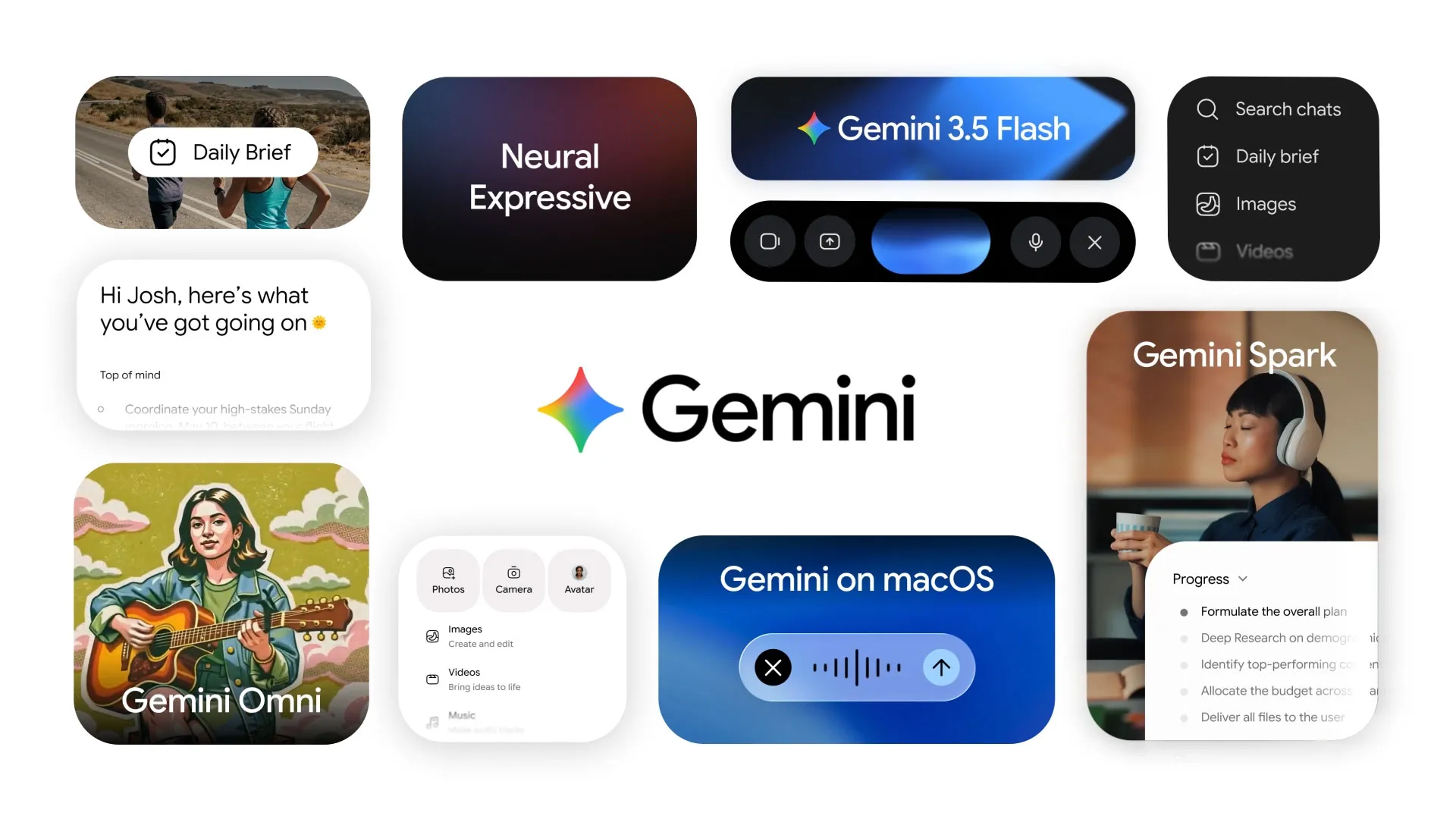
The Gemini app, which is Google’s answer to ChatGPT, got a complete visual redesign called Neural Expressive. New typography. Fluid animations when you scroll. Haptic feedback when you tap things. It started rolling out on May 19 on Android, iOS and the web.
You might be wondering, why does Google care so much about how the app looks. Here is the honest answer. Most people use ChatGPT and Claude, not Gemini. Google is the third or fourth choice for people asking AI for help, even though their model is technically among the best. So they are pouring effort into making the app feel premium and worth opening. The Neural Expressive design is part of that fight for daily users.
Gemini Spark and Daily Brief from Google I/O 2026
This is the part of Google I/O 2026 that genuinely changes how you might use an AI in real life. Google launched two new agent features.
Gemini Spark is a personal AI agent that runs 24 hours a day, 7 days a week, in Google’s cloud. Not on your phone. In the cloud. That means it keeps working even when your phone is off and you are asleep. It can read your Gmail, look at your Google Docs, peek at your Sheets, check your Calendar. And it can take action across all of them without you opening any app.
The example Google showed at the keynote was very practical. You give Spark access to your credit card statement. It scans for recurring subscriptions you forgot about. It tells you, you are paying $14 a month for a streaming service you have not used in eight months, want me to cancel. Another example. You get an email from your child’s school about a parent teacher meeting. Spark reads it, adds it to your calendar, sets a reminder, and drafts a confirmation reply for you to approve. You just hit send.
The second feature is called Daily Brief. Every morning, it puts together a short summary of your day. Pulls from your calendar, your inbox, your tasks, your travel plans. The closest comparison is the daily morning briefing executive assistants used to write by hand for their bosses. Now you have that, even if you are not an executive. It started rolling out to US users on Google AI Plus, Pro and Ultra plans from May 19.
Google I/O 2026 Brought the Biggest Search Change in 25 Years
This one is huge and most people are going to feel it. The Google search box you have used since 2001 is being completely rebuilt. Instead of typing two or three keywords and clicking blue links, you can now have a full conversation with Search. You can upload pictures, paste video, and follow up on the previous answer, all inside the same search session.
Behind the scenes, the new search box runs on Gemini 3.5 Flash. Google calls it the “intelligent search box” and it is rolling out globally in every country and language where AI Mode is already available. AI Mode itself crossed one billion monthly users at I/O 2026, just twelve months after launch. That is faster adoption than any feature Google has shipped since Maps.
Google also previewed a feature called Information Agents. These are background AIs that watch the internet for you, around the clock. You tell it, alert me if anything changes about my flight on Friday, or wake me up if a particular stock crosses a price, or tell me when the school district publishes the new term schedule. The agent watches blogs, news sites, social posts, real time data feeds, and pings you when something matches. Launches this summer for paid subscribers in the United States first.
Google I/O 2026 and Antigravity 2.0: How Apps Get Built Now
If you are not a developer this section might feel less relevant, but stick with it because the implications are real. Google launched Antigravity 2.0, a brand new platform for building software using AI agents that write the code for you.
What is different from old AI coding tools. The old way was, you sit in a code editor, AI suggests code as you type, you accept or reject. The new way is, you tell the AI what you want, walk away, and it goes off and builds the thing. Antigravity 2.0 includes a desktop app, a command line tool, a developer kit for building your own agents, and native support for building Android apps from a prompt.
Google announced a new pricing tier alongside it. $100 per month AI Ultra plan which gives you 5 times the usage limits of the regular AI Pro plan. This is the same price tier Anthropic charges for premium Claude. Google is signalling that the era of free unlimited AI is over for power users.
If you run a business that builds software, this is the moment to evaluate Antigravity against your current setup. We wrote a separate deep dive on AI coding agents earlier this month covering the broader market including Cursor, Claude Code, Devin and Windsurf.
The Google I/O 2026 Creative Stack: Veo, Imagen, Lyria and Flow
Google’s creative AI models all got updates at Google I/O 2026.
Veo 3 for video
Generates short video clips from text or images. Better character consistency, smoother motion, and now available on Vertex AI for developers and businesses.
Imagen 4 for pictures
The fourth generation of Google’s image generator. Sharper detail, far better at typography (so signs and logos in generated images actually read correctly), and tighter prompt following.
Lyria 2 for music
Generates original music clips from a written prompt. Great for marketers, video creators, and anyone who needs a soundtrack without licensing a song.
Flow for filmmaking
A dedicated tool that wraps Veo and gives filmmakers control over characters, scenes, camera angles and styles across a whole sequence. The closest thing to AI assisted directing that has shipped publicly.
Smart Glasses from Google I/O 2026: Samsung, Warby Parker, Gentle Monster
This was the showstopper of Google I/O 2026. Google is shipping smart glasses this fall. Not Google Glass version two with the dorky cube on the side. Actual glasses, designed by Warby Parker and Gentle Monster, that look like regular eyewear. Samsung is making them. Qualcomm chips inside. Android XR is the operating system. Gemini is the AI.
The first wave is audio only. No display, no camera viewfinder. You just say “Hey Google” or tap the frame, and the assistant talks back to you in your ear. Real time language translation that preserves the speaker’s voice. Walking directions. Reading your messages aloud. Adding things to your calendar. They work with iPhones too, not just Android. Launches fall 2026 in select markets.

Google I/O 2026 Workspace, Pixel and Android Updates
Beyond the headline AI stuff, Google announced a bunch of smaller updates that add up.
Voice in Workspace. You can now talk to Gmail, Docs and Keep. Dictation has been around forever, but this is conversational. You say “summarize this thread and draft a reply that asks for a 15 minute call” and it does the whole thing.
Google Pics. A new design tool for making images, logos and quick graphics. Aimed at small businesses and content creators who do not want to learn Photoshop or Canva.
Universal Cart. A shopping feature where you can chat about a product anywhere on Google and add it to one universal cart. Buys from any merchant. Streamlines checkout.
Ask YouTube. Type a complex question into YouTube search and get a list of the most relevant videos along with an AI summary of what they cover.
Android 17. The next major version of Android lands in June or July 2026, before the new Pixel phones come out. Pixel devices get it first.
Pixel 11. Google did not officially launch the next Pixel at I/O. But leaks and beta code confirm that Pixel 11 is coming in August 2026 with the new 2 nanometre Tensor G6 chip, and a Pixel 11 Pro Fold lands in October. A new feature called Pixel Glow adds an RGB notification light strip.
What Google I/O 2026 Means for Regular People
Strip out the technical jargon and Google I/O 2026 boils down to four shifts that affect everyone.
You will type less, talk more
The classic Google search box is becoming a conversation. Expect to ask longer questions, attach images, and have follow up exchanges. SEO and how brands appear in search results will shift accordingly over the next year.
AI now does work while you sleep
Gemini Spark and Information Agents represent a real category shift. AI is no longer just something you open when you need help. It runs in the background, watches things for you, takes actions on your behalf.
Glasses are the next phone
Smart glasses with Gemini in your ear are shipping this fall. Samsung is making them. Warby Parker is designing them. Expect Apple to respond and the whole face computing category to take off through 2027.
Premium AI now costs $100 a month
Google introduced AI Ultra at $100 per month, matching Anthropic’s Claude Max pricing. The free tier is still there but heavy users will pay. Your annual AI bill is going up.
What Google I/O 2026 Means for Businesses
If you run a business, there are five practical things to do in the next two quarters based on what came out of Google I/O 2026.
Update your SEO playbook
When Search becomes a conversation, ranking for keywords gets replaced by ranking inside AI generated answers. Schema markup, FAQ structure and clear entity definitions matter more than ever.
Trial Gemini Spark for one workflow
Pick one repetitive admin task, like processing inbound emails or maintaining a status report, and pilot Spark on it. Real productivity gains come from one workflow done well, not ten done lightly.
Evaluate Antigravity for your engineering team
If you ship software, run a 30 day pilot of Antigravity 2.0 against Cursor and Claude Code on the same backlog. The differences are real and worth measuring.
Plan for voice as a real interface
Smart glasses, voice in Workspace, and conversational Search all point the same direction. Your customers will ask their AI before they ask you. Make sure your business is structured to be discoverable in that conversation.
One thing to keep in mind. Google announced a lot at I/O 2026, but rolling things out takes months. Most features land in waves between now and December. The smart move is to start preparing now, not wait until everything has shipped.
How Precision Pulse Helps Businesses Act on Google I/O 2026
At Precision Pulse, we help operating teams cut through the noise of major announcements like Google I/O 2026 and turn them into one or two clear actions. We pilot tools like Gemini Spark, Antigravity 2.0 and the new Search behaviour against real workflows in your business. We rewrite your SEO and discoverability strategy for conversational search. And we set up the analytics so you can see, in your numbers, what is actually working.
See our AI automation services if you want a real conversation about putting these announcements to work. And read our companion analysis on AI coding agents and AI infrastructure deals 2026 for the broader context this year.
Google I/O 2026 Frequently Asked Questions
What was the biggest announcement at Google I/O 2026?
The biggest single announcement at Google I/O 2026 was the launch of Gemini 3.5 Flash as the new default model across Search, the Gemini app and Workspace. The most impactful long term shift was the introduction of personal AI agents like Gemini Spark and the redesign of Google Search itself, which the company called the biggest change to Search in 25 years.
Is Gemini 3.5 free or paid?
Gemini 3.5 Flash is free for everyone through the Gemini app and AI Mode in Search. Gemini 3.5 Pro, the more powerful model, launches in June 2026 and is part of the Google AI Pro and Ultra plans. The new AI Ultra plan costs $100 per month and unlocks 5 times the usage limits in Antigravity and other paid features.
When do the new Google smart glasses launch?
The new Samsung and Google intelligent eyewear announced at Google I/O 2026 launches in fall 2026, in select markets first. The first wave is audio only with Gemini built in, designed by Warby Parker and Gentle Monster, with Qualcomm Snapdragon chips inside. They work with both Android phones and iPhones.
What is Gemini Spark and when can I use it?
Gemini Spark is a 24/7 personal AI agent that runs in Google’s cloud, not on your device, and can take actions across Gmail, Docs, Sheets, Calendar and other Google apps even when your phone is off. It started rolling out to trusted testers in the week of I/O 2026 with a beta release for US Google AI Ultra subscribers expected shortly after.
Will Google I/O 2026 changes affect SEO?
Yes, significantly. The new conversational Google Search box and the rollout of Personal Intelligence in AI Mode to 200 countries change how businesses appear in search results. Traditional keyword ranking matters less. Schema markup, FAQ blocks, clear entity definitions and topical authority matter more. Businesses should audit their SEO setup over the next two quarters in light of these changes.
Want help turning Google I/O 2026 into action for your business?
Big announcements only matter if you do something with them. We help businesses pilot Gemini Spark, Antigravity 2.0 and the new search behaviour against real workflows, and rewrite SEO and content strategy for the conversational Search era.
Why Google I/O 2026 matters for operating decisions
Most of what Google announced at Google I/O 2026 will be in everyday use within six months. The companies and people who adjust their workflows, content and discoverability now will compound a quiet advantage through 2027. The ones who wait will spend the rest of the year catching up.